

Latest News
CH4 Global™ delivers Methane Tamer for South Australia’s first continuous commercial use
22 January 2024
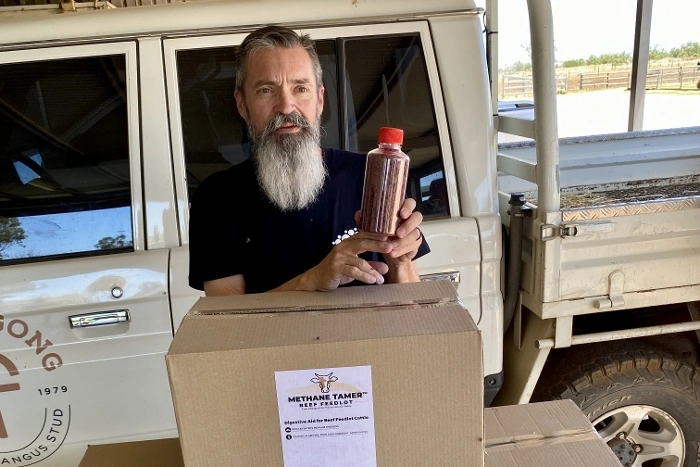
CH4 Global has hand-delivered its first commercial quantity of its seaweed supplement to CirPro Australia. Methane Tamer, a quality, shelf-stable commercial product of asparagopsis is designed for a consistent and efficient delivery to the livestock and dairy industries.
CH4 Global™, Inc., continues its path to bend the climate curve and radically reduce methane emissions by 2030. Today, the Adelaide-raised CEO of CH4 Global, Dr Steve Meller, was in Port Pirie, South Australia to hand deliver the world’s first Methane Tamer commercial product to CirPro Australia CEO, Reg Smyth.
A year on from the first international feedlot trial of CH4 Global’s initial asparagopsis seaweed supplement, the improved product will now be commercially sold to CirPro for use at its partner feedlot HB Rural, south of Port Pirie.
“We are very excited about Methane Tamer, which addresses key aspects of the variability with use of Asparagopsis seaweed by providing a consistent, stable quality finished product for use on farms,” Mr Smyth said.
“For this first Methane Tamer commercial delivery, we are pleased to continue our collaboration with CH4 Global and be at the forefront of important industry change through the use of this product.”
“Our companies are committed to sustainable protein production, but we are also focussed on realised efficiencies, the highest levels of methane reduction, positive commercial outcomes and animal welfare. These four pillars are not negotiable. This first commercial sale and use of Methane Tamer is the foundation for our previously announced partnership and now with the application of Methane Tamer at scale, we will continue to build the best data to date which will progressively inform our operations, our customers and the industry.”
Dr Meller said the supply of CH4 Global’s new Methane Tamer feed supplement to CirPro was the culmination of key efforts to produce a finished product that met or exceeded the consistent quality or product needed to maximize impact delivering the best outcomes for our planet.
“We have been steadfast on this since our inception. Our ongoing investment in R&D for efficient reliable growth of asparagopsis plus refinements of our proprietary processing techniques allows us to deliver the highest quality value product with costs low enough for farmers to have a positive return on their investment without the need for subsidies and it also enables us to be sufficiently profitable to access project capital to build infrastructure at scale to exponentially increase our output,” Dr Meller said.
Based on measurements of methane produced by feedlot cattle, each cow produces approximately 32Kg of methane over a 100-day feedlot period. This equates to approximately 896kg of CO2 Greenhouse Gas (GHG) equivalent based on the accepted Global Warming Potential (GWP) of 28 over 100 years.
“That means for 100 cattle in a feedlot for 100 days, we will eliminate the equivalent GHG emissions of approximately 100 trips between Sydney and Perth driven by an average petrol-powered passenger vehicle, or 45,000 kilograms of coal burned,” Mr Smyth said.
“Another way of looking at it is this reduction is equivalent to carbon sequestered by 1,500 tree seedlings grown for 10 years. Whatever way you view it, this is significant and direct GHG mitigation.”
CirPro plans to be scaling this, in partnership with CH4 Global, to 10,000 cattle daily by early 2025.
“Our focus will remain firmly on sustainable production and processing of protein with a commitment to direct reductions of GHG and water use with increased efficiencies through Industry 4.0 changes,” Mr Smyth said.
“The construction of our new processing facility will commence this year and will be the crown on our sustainable protein supply chain design. The world is already alert to questionable “carbon neutral” claims through offset measures. We believe customers will increasingly consider this unacceptable and demand that we can demonstrate direct mitigation through our production innovation. The first direct controls for vehicle emissions started over 60 years ago. Governments didn’t accept offset measures to reduce emission levels then. Why would this industry be any different now that effective mitigation is available?”
Recent News
- When someone says they’re not OK, would you know what to do?
- First day of school for newest Facility Dog Westy
- Internal communications: the overlooked key to attracting and retaining talent
- Artists step up in support of people experiencing homelessness
- Cardiac breakthrough offers potentially life-saving treatment for more patients
- On your paws... go! Let's walk with purpose at the last ever PAWGUST
- Breaking Bad (News)
- More choice and more capacity for Adelaide travellers as Singapore Airlines goes 12 times weekly
- International students hit country roads on jobs drive
- Detpak opens US manufacturing facility in Spartanburg, South Carolina
- Yugo Perth University Campus Student Accommodation Building Opens in Waterford
- Blog: Broadcasting vs. Narrowcasting: Why Modern PR Needs Both
- Walk with purpose at our last ever PAWGUST!
- New CFO and expanded Board under Unity Housing merger
- China Eastern arrival links Adelaide and Shanghai for the first time
- Parkinson’s Australia continues campaign against herbicide banned in 70 countries
- Digging up the next generation of builders
- Cold Temperatures Drive Demand at Hutt St Centre
- Native title pioneer Parry Agius to lead SA's largest Aboriginal aged care provider
- Blog: Why most website redevelopments fail to move the needle
 We'd love to chat